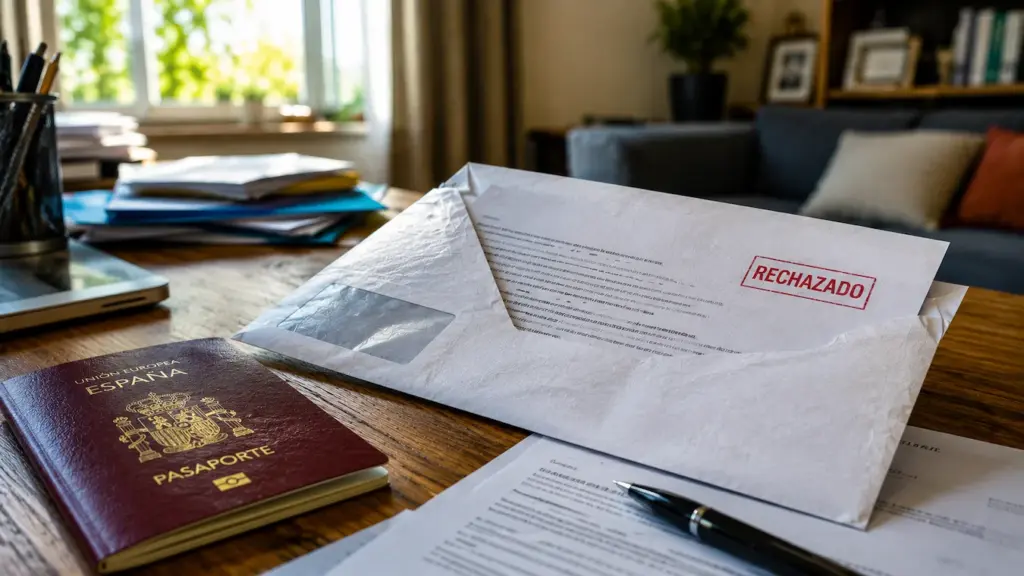
Having your Non-Lucrative Visa Spain denied is frustrating, but it is not the end of your journey. In most cases, denials are caused by avoidable documentation errors — not because the applicant is fundamentally ineligible. At Klev & Vera, we have reviewed hundreds of denied NLV applications, and the vast majority could have been approved with proper preparation. This guide explains the seven most common reasons for rejection, your legal options for appeal, and the concrete steps you can take to fix your application and reapply successfully.
When a Spanish consulate denies a Non-Lucrative Visa application, it issues a written resolution (resolución denegatoria) that must specify the legal grounds for the decision. Understanding these reasons is the critical first step — because the path forward depends entirely on what went wrong.
Based on our practice at Klev & Vera, these are the seven most frequent reasons for NLV denial in 2026, ranked by how often we see them:
1. Insufficient or poorly documented financial proof
This is the number one cause of Non-Lucrative Visa denials across all Spanish consulates worldwide, and it accounts for roughly half of the cases we review.
The requirement is clear: €28,800 per year for a single applicant (400% of the IPREM), plus €7,200 per dependent. But meeting the number is only part of the equation. Consulates evaluate how the money is presented, and common failures include:
- Bank statements that do not cover 12 months. Some applicants submit only 3 or 6 months of statements, which is insufficient to demonstrate financial stability.
- A recent large deposit without explanation. If your bank account shows a balance of €10,000 for 11 months and then suddenly jumps to €35,000 the month before the application, the consular officer will suspect the funds were borrowed or temporarily transferred. This is one of the most common triggers for denial.
- Statements that do not clearly identify the account holder. If your name does not appear on every page, or if the statements are from a joint account with someone who is not part of the application, this creates ambiguity.
- Income sources that are not clearly passive. If your bank statements show regular deposits that look like salary payments — even if they are dividends or rental income — the consulate may question whether you are working.
- Currency conversion issues. If your income or savings are in a currency other than euros, ensure the conversion clearly exceeds the threshold. A balance of $30,000 USD may fall below €28,800 depending on the exchange rate on the date of review.
How to avoid this: Present 12 months of consecutive bank statements from the same institution, with your full name on every page. If you have multiple income sources, include a cover letter (carta explicativa) that maps each deposit to its source. If possible, supplement with a bank certificate (certificado bancario) confirming the average balance over the past year. For detailed guidance on financial requirements, see our complete guide to the Non-Lucrative Visa Spain.
2. Inadequate health insurance
The second most common reason for denial is health insurance that does not meet the strict Spanish immigration requirements. Many applicants purchase a policy without verifying that it complies, and by the time the consulate rejects the application, the appointment slot is lost.
The most frequent insurance-related errors include:
- Purchasing travel insurance instead of private health insurance. Travel insurance with medical assistance coverage is explicitly rejected by all Spanish consulates.
- Policies with copayments (copagos). If the policy requires the holder to pay any amount at the point of care — even €10 per visit — it will be rejected.
- Policies with waiting periods (periodos de carencia). If certain conditions or treatments are excluded during the first months of coverage, the policy does not meet the requirements.
- Coverage limits or annual caps. Policies with a maximum annual payout (e.g., €100,000 per year) do not qualify.
- Insurance from a provider not authorized in Spain. The insurer must be authorized by the Dirección General de Seguros y Fondos de Pensiones (DGSFP) to operate in Spain.
How to avoid this: Before purchasing insurance, explicitly ask the provider: “Does this policy comply with the requirements for a Non-Lucrative Visa in Spain?” Get written confirmation. Insurers commonly used for NLV applications include Sanitas, Adeslas, Asisa, MAPFRE, and DKV. Expect to pay between €800 and €3,000 per year depending on age.
3. Criminal record issues
A clean criminal background check is required from the applicant’s country of residence and from any other country where the applicant has lived during the past five years. Problems arise in several ways:
- The certificate is not apostilled. An FBI Identity History Summary, for example, must be apostilled by the U.S. Department of State’s Office of Authentication — not by a state-level apostille. This is a critical distinction that many applicants get wrong.
- The certificate is not translated by a sworn translator (traductor jurado). Consulates do not accept unofficial translations, translations by regular translators, or self-translations.
- The certificate has expired. Most consulates require the criminal record to have been issued within the 90 days (or in some cases 6 months) prior to the application date. If your consular appointment is delayed, the certificate may expire.
- The applicant failed to include records from all countries of residence. If you lived in two countries during the past five years, you need certificates from both.
How to avoid this: Apply for your criminal background check as one of the first steps in the process, and plan for the longest possible processing time. FBI checks can take 4 to 18 weeks. RCMP checks in Canada take 8 to 12 weeks. Factor in additional time for apostille and sworn translation.
4. Expired documents at the time of submission
Documents have expiration dates, and consular appointments are often delayed — sometimes by weeks or months. When the appointment finally arrives, the applicant discovers that their medical certificate or criminal record has expired since they obtained it.
This is particularly common at high-demand consulates in New York, Los Angeles, London, and Toronto, where appointment availability can be limited.
How to avoid this: Work backwards from your expected appointment date when ordering time-sensitive documents. If your appointment is in three months, do not order your medical certificate now — order it six weeks before the appointment. Build a document timeline that accounts for each item’s validity period.
5. Incomplete or incorrectly filed forms
The Non-Lucrative Visa requires multiple forms, each with specific fields that must be completed in a particular way:
- Form EX-01 must be completed entirely in Spanish, with a valid Spanish address (not a hotel). The address must include the full format: street, number, floor, door, postal code, city, and province.
- Form 790, code 052 must have the correct box ticked: “Autorización inicial de residencia temporal.”
- The national visa application form must be signed by the applicant (or by a parent if the applicant is a minor).
Missing a single field, ticking the wrong box, or failing to sign can result in an immediate rejection without substantive review.
How to avoid this: Have your forms reviewed by someone who has successfully submitted applications at the specific consulate where you are applying. Each consulate has its own informal expectations beyond the written requirements.
6. Missing or deficient notarized affidavit
Many consulates — particularly in the United States — require a notarized affidavit (declaración jurada) that includes three specific elements: a brief professional background, the address in Spain, and a commitment not to engage in any gainful work, including remote work.
Denials occur when the affidavit is missing, when it omits the remote work commitment (which is now explicitly required), or when it is signed but not properly notarized.
How to avoid this: Ensure your affidavit includes the explicit language: “I commit to not engaging in any gainful work, by any means, either on-site or remotely (online), while residing in Spain.” Have it notarized by a public notary and, if applying from outside Spain, apostilled.
7. Indication of intent to work
The Non-Lucrative Visa is predicated on the applicant not working in Spain. Any indication — even unintentional — that the applicant plans to work can trigger a denial:
- Mentioning remote work, freelance projects, or “digital nomad” activities in the affidavit or during the consular interview.
- Bank statements showing regular income that appears to be salary.
- LinkedIn profiles that show current active employment (yes, some consulates check).
- Active business registrations in the applicant’s home country.
How to avoid this: Be consistent across all documents and platforms. If you are currently employed, you may need to provide evidence of employment termination or a formal leave of absence. If you intend to work remotely, the Non-Lucrative Visa is not the right visa — consider the Digital Nomad Visa instead.
Your Non-Lucrative Visa Was Denied: What Are Your Legal Options?
Expat communities on Reddit (r/expats, r/GoingToSpain, r/IWantOut) are full of questions about denied NLV applications. Here are the most common:
Option 1: Administrative appeal
This is an internal review carried out by the same body that issued the denial — typically the consular office. Key details:
- Deadline: One month from the date you receive the denial notification.
- Cost: No fee.
- What to include: A formal letter (in Spanish) addressing each reason for denial, accompanied by supporting documents that correct the deficiencies identified. For example, if the denial was based on insufficient financial proof, submit additional bank statements, a bank certificate, or a letter from your pension provider.
- Resolution time: Variable, typically 1 to 3 months.
- Important: While the recurso de reposición is pending, you are not in an irregular situation if you were applying from outside Spain.
The recurso de reposición is often the fastest path to resolution, particularly when the denial was based on a documentation error that can be corrected with additional evidence.
Option 2: Judicial appeal
If the recurso de reposición is unsuccessful — or if you prefer to go directly to court — you can file a judicial appeal before the Spanish courts.
- Deadline: Two months from the date of the denial (or from the date the recurso de reposición was rejected).
- Court: Juzgados Centrales de lo Contencioso-Administrativo in Madrid.
- Cost: Court fees plus legal representation. You will need a Spanish lawyer (abogado) and a court representative (procurador).
- Resolution time: 6 to 18 months, depending on court workload.
- When to consider this: When the denial was based on a legal misinterpretation by the consulate, when the consulate applied requirements that exceed what the law mandates, or when the recurso de reposición was rejected without adequate justification.
Option 3: Resubmit a new application
In many cases — particularly when the denial was caused by expired documents, missing forms, or an insurance policy that did not meet the requirements — the most practical option is simply to correct the errors and submit a new application.
This does not require waiting for an appeal to be resolved. You can reapply immediately, though you will need to book a new consular appointment and pay the fees again.
When resubmission is better than appeal: When the issue is clearly fixable (wrong insurance, expired document, missing form) and there is no dispute about eligibility. An appeal takes months; a corrected resubmission can be resolved in weeks.
What Reddit Users Ask About NLV Denials
Expat communities on Reddit (r/expats, r/GoingToSpain, r/IWantOut) are full of questions about denied NLV applications. Here are the most common:
- Can I reapply after being denied?
Yes, you can reapply immediately. There is no waiting period or penalty for reapplication. However, if you reapply with the same deficiencies, you will receive the same result. Fix the issue first.
- Does a denial affect future visa applications?
A single NLV denial does not create a blacklist or permanent mark on your immigration record. However, multiple denials at the same consulate may lead to increased scrutiny on subsequent applications. If you have been denied, it is worth investing in professional legal review before reapplying.
- Can I apply at a different consulate after being denied?
No. You must apply at the consulate with jurisdiction over your place of legal residence. You cannot “consulate shop” by applying at a different location to avoid the one that denied you.
- I was denied because of "insufficient financial means" even though I meet the threshold — what happened?
This is more common than you might expect. Some consulates interpret the financial requirement more strictly than others, requesting up to double the legally established minimum or requiring both regular income and liquid savings. If you believe the consulate applied excessive requirements, this is a strong basis for an appeal — and Spanish courts have ruled in favor of applicants in similar cases.
- Should I hire a lawyer for a denied NLV application?
If the denial was based on a simple documentation error (expired certificate, missing form), you can likely fix it yourself. If the denial involves a subjective assessment (financial means deemed insufficient despite meeting the threshold, doubts about intent to work), legal representation significantly improves your chances — particularly if an appeal is necessary.
How Klev & Vera Can Help After a Denial
At Klev & Vera, our immigration team specializes in recovering denied Non-Lucrative Visa applications. Our process includes:
Denial Review. We analyze your resolución denegatoria line by line to identify the exact legal and factual basis for the rejection.
Strategy Assessment. Based on the denial reasons, we recommend the fastest path forward: recurso de reposición, judicial appeal, or corrected resubmission. We never recommend an appeal when resubmission is faster and more effective.
Document Correction. If the denial was based on documentation deficiencies, we prepare a complete corrected file that addresses every point raised by the consulate.
Appeal Drafting. If an appeal is warranted, our litigation team drafts the recurso in Spanish, supported by the relevant legal provisions and — where applicable — favorable court precedents.
Consulate-Specific Knowledge. We know how each consulate interprets the requirements, which ones are stricter on financial proof, which ones check LinkedIn profiles, and which ones require the affidavit in a specific format. This knowledge is often the difference between a second denial and a successful outcome.
To discuss your denied Non-Lucrative Visa application, contact our team at info@klevvera.com, call us at +34 93 17 60 190 (Spain), +44 203 868 94 90 (UK), or +1 646 475 67 89 (USA), or visit www.klevvera.com to book a consultation.